ICPN Proposal for Adopting Peace Studies as a Core Element of the National Curriculum

EXECUTIVE SUMMARY

The International Children’s Peace Network (ICPN) proposes that Peace Studies be embedded as a core component of the national curriculum across primary and secondary phases. The aim is to equip children with practical competencies in conflict resolution, empathy, media and information literacy, intercultural understanding, civic responsibility, and restorative practice – all of which directly support safer schools, improved attainment, and stronger social cohesion.

The International Children’s Peace Network (ICPN) is uniquely placed to deliver this with government: it runs school-facing programmes, youth leadership and interfaith dialogue activities, teacher training seminars, and national platforms (such as the International Children’s Peace Assembly which launched the Children’s Peace Declaration in the House of Lords this summer). ICPN’s partnerships – Rotary International, various faith and non-faith networks, and education organisations – ensure national reach and multi-stakeholder credibility. In pursuance of this objective, we request urgent meetings with the DfE (and relevant bodies in the UK and Europe) to discuss piloting and scaling.

THE CASE FOR PEACE STUDIES 

Educational and Social Outcomes

  • Behaviour and safeguarding: Evidence across UK schools shows that restorative approaches and peer mediation reduce exclusions, bullying, and teacher workload while improving relationships and attendance.
  • Attainment and wellbeing: Social-emotional learning and values-based education improve readiness to learn, concentration, and classroom climate – indirectly raising attainment.
  • Civic readiness: With increasing youth civic participation (and ongoing debate around voting at 16), Peace Studies prepares students for informed, respectful democratic engagement.
  • Countering misinformation and extremism: Structured media literacy and dialogue skills help young people navigate polarisation, harmful online content, as well as mis/disinformation.

Alignment with UK Policy Priorities

  • It supports the DfE’s focus on behaviour, attendance, safeguarding, character education, RSHE/PSHE, and citizenship.
  • It complements the government’s Prevent programme and EQUaL ambitions by building resilience, inclusion, and critical thinking rather than fear-based compliance.
  • It is consistent with Ofsted’s emphasis on personal development, Spiritual, Moral, Social and Cultural development (SMSC), and the wider curriculum.

WHAT PEACE STUDIES LOOKS LIKE (CORE COMPETENCIES)

Intrapersonal and Social Skills – self-management, empathy, communication, active listening.

Conflict Transformation – peer mediation, restorative conversations, de-escalation.

Intercultural and Interfaith Literacy – respectful dialogue, shared values, inclusion.

Civic and Ethical Reasoning – rights, responsibilities, deliberation, service learning.

Media and Information Literacy – bias detection, fact-checking, digital civility.

Community Peacebuilding – student-led projects that connect school, family, and locality.

Assessment emphasises reflective practice, collaborative problem-solving, and contribution to school/community life, rather than high-stakes examinations.

UK AND INTERNATIONAL PRECEDENTS (SELECTED)

 United Kingdom

Restorative Practice and Peer Mediation programmes have run widely across England, Wales and Scotland, demonstrating improvements in behaviour and school culture.

UNICEF Rights Respecting Schools Award (thousands of UK schools) shows how rights-based culture boosts respect, inclusion, and pupil voice—natural foundations for Peace Studies.

Peace education networks (e.g., Quaker-led initiatives, regional “Peacemakers/Peaceful Schools” projects, and PeaceJam UK) already deliver proven resources and CPD in British classrooms.

 International

Colombia (Cátedra de la Paz) – mandated peace education following a peace process, with civic engagement and coexistence competencies.

Philippines – a national policy mainstreaming peace education across the curriculum.

Rwanda and Sierra Leone – post-conflict curricula embedding reconciliation, social cohesion and citizenship.

Costa Rica – longstanding national emphasis on peace and civic education, supported by universities and teacher education.

Nordic systems (Finland, Norway) – strong Social and Emotional Learning (SEL) phenomenon-based learning, and media literacy embedded across subjects.

These examples demonstrate that structured peace education is deliverable at scale, measurable, and compatible with high academic standards.

ICPN – CAPACITY TO DELIVER

Our motto at ICPN is Peace Begins with Me – Building Peace in Families, Schools, and Communities

 ICPN Current (2025–2026) programme

  • In Schools: interactive workshops, teacher training, student-led Peace Clubs.
  • Peace Debates and Leadership: regionalandnational debates mentored by Rotary Peace Fellows and community leaders.
  • Interfaith and Inclusion Events: Annual Interfaith Peace Gathering; Peace in the Family
  • International Children’s Peace Assembly (House of Lords, London, August 2025, planning for 2026 underway): a flagship platform amplifying youth voice.
  • Children’s London Peace Marathon (June 2026): public mobilisation on peace and inclusion.
  • Partnerships and Community Action: Rotary International, Women’s Interfaith Network, Universal Peace Federation, and many others – the list of stakeholders is growing.
  • Recognition and Legacy: Peace Ambassador Awards; a developing Peace Curriculum Framework for Schools (2025–2026).

Why ICPN are uniquely positioned

  • School access and partnerships across diverse regions via Rotary International and networks.
  • Delivery experience with teacher Continuing Professional Development, assemblies, debates, and student projects.
  • Non-partisan convening power to bring together government, schools, civil society, and families
  • Cultural and interfaith literacy to reach communities often under-served by national initiatives.
  • Ready-to-run pilots and a national youth platform to showcase outcomes / build momentum.

IMPLEMENTATION PATHWAYS FOR THE DfE

  1. Core Strand within PSHE/Citizenship (fastest route)
  • Define Peace Studies competencies and mapped outcomes across Key Stages 1–4.
  • Publish statutory guidance for delivery and assessment via PSHE/citizenship.
  • Commission DfE-endorsed CPD (Continuing Professional Development) and resource packs (leveraging ICPN + partners).
  1. Standalone Subject Pilot (evidence-building route)
  • Pilot Peace Studies as a timetabled subject in a representative set of schools/Multi Academy Trusts (MATs) for 12–18 months.
  • Independent evaluation (behavioural data, attendance, exclusions, climate surveys, attainment links). 
  1. Whole-School Restorative and Peace Culture

DfE promotes a national framework for restorative practice, peer mediation, and student leadership, with Peace Studies as the curricular engine.

  • Incentivise through character education funding and recognition/awards.

All of the above recommended pathways are complementary; the DfE may choose a hybrid approach beginning with the first while commissioning pilots under the second, for example.


ICPN – DFE PILOT OFFER (2025–2026)

Scope: 10 – 20 schools across different regions; a mix of primary/secondary, urban/rural, and diverse demographics.

Components:

  1. Curriculum Pack mapped to PSHE/Citizenship and SMSC (KS1–4).
  2. Teacher CPD (introductory + coaching cycles).
  3. Student Leadership (Peace Clubs; peer mediators; debates; service learning).
  4. Community Linkages (Rotary clubs; interfaith partners; local councils).
  5. Monitoring and Evaluation (baseline + termly data on behaviour, attendance, climate, pupil voice; qualitative case studies).
  6. Showcase Platforms (Children’s Peace Assembly; DfE/Ofsted engagement days).


Timeline

1st Quarter 2026: Co-design with DfE; select schools/MATs; train cohort 1.

2nd to 3rd Quarter(s) 2026: Delivery and evaluation; inaugurate the National Children’s Peace Marathon  as a public engagement programme.

4th Quarter 2026: Report to DfE with results and options for scale-up; White Paper submission.


Safeguarding, Inclusion, and Quality Assurance

The project will be fully aligned with Keeping Children Safe in Education and statutory safeguarding duties.

It will be inclusive by design (Special Educational Needs and Disabilities – SEND, English as an Additional Language – EAL, faith and non-faith contexts.

It will encapsulate neutral, evidence-based materials that do not proselytise but build universal competencies and respect for diversity.

There will be an in-build external advisory board (made up of selected academics, safeguarding leads, headteachers, and youth representatives) for oversight.


Costs and Funding (indicative, subject to scoping)

Curriculum and resources: development + licensing.

CPD: training days + coaching support.

Evaluation: independent partner + data tools.

Events and youth platforms: debates, Assembly, Marathon.

Funding options: DfE pilot grants, local authority innovation funds, Rotary and other non-profit sponsorships / grants, corporate CSR (corporate social responsibility support), and charitable trusts.


Risk Management (Brief SWOT Analysis)

Timetable pressure: integrate within existing PSHE/citizenship time; micro-modules for other subjects.

Workload: provide ready-to-use lesson sequences and 1-page guidance; coaching instead of just one-off training.

Community sensitivities: neutral, rights-based framing; parental communication packs.

Consistency: common competency framework, standardised teacher rubrics, and simple evaluation dashboards.

Public Mandate and Engagement

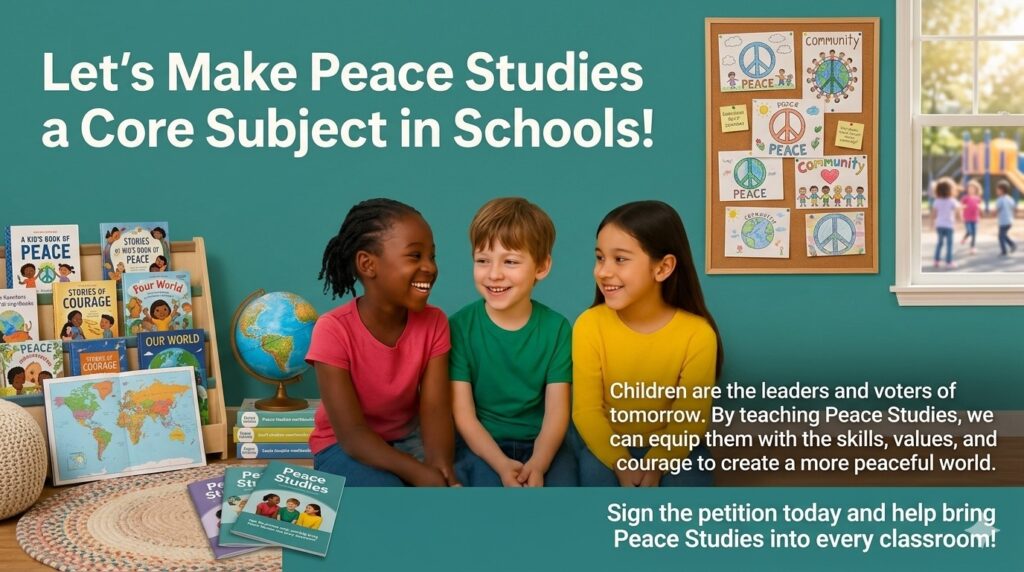
ICPN (with Rotary and partners) is launching a national petition supporting Peace Studies in schools. This will evidence wide public support from parents, pupils, teachers, governors, and community leaders. ICPN will ensure all campaign materials are non-partisan, accurate, and DfE-compliant.

Requests to the Department for Education

Urgent meeting with officials to discuss integration of Peace Studies and agree a joint pilot for 2026.

DfE nomination of a policy lead to join ICPN’s steering group with Rotary and education partners.

Agreement in principle to explore statutory guidance and/or a funded pilot pathway (as above).

DfE liaison with relevant UK and European bodies (e.g., devolved education departments, British Council, Council of Europe networks) to share practice and coordinate scale-up.

CONCLUSION

Embedding Peace Studies is a practical, evidence-aligned step that serves the DfE’s priorities on behaviour, safeguarding, character education, and citizenship—while strengthening attainment and social cohesion. ICPN, led operationally by Nellie Stefanova, CEO and founder of ICPN, and supported by a national partnership network, offers a ready-to-deliver model with teacher CPD, student leadership, and rigorous evaluation.

We welcome the opportunity to meet at the earliest convenience to discuss how the Department can work with ICPN to pilot, evidence, and scale Peace Studies as part of a world-class, future-ready curriculum.

 Yours Sincerely,

Nellie Stefanova

The following appendices were consulted in this proposal (available on request):

ICPN Policy Paper: Introducing Peace Studies as a Core Subject

Programme Summary 2025–2026 (Education, Debates, Interfaith, Assemblies, Marathon, Awards)

Draft Competency Framework & Curriculum Map (KS1–4)

Pilot School Offer & CPD Outline

Evaluation Framework (behaviour, attendance, climate, pupil voice)

Letters of Support (Rotary, partner organisations, headteachers)

You can sign the petition using this link…

Scroll to Top